They ate the whole animal.
Nothing was wasted.
Five grass-fed organs — liver, heart, kidney, pancreas and spleen — freeze-dried whole and sealed into a capsule. The nourishment your grandmother took for granted, without the cast-iron skillet, the soaking, or the smell in the kitchen.
You already remember this food.
Maybe your mother made liver on Thursdays. Maybe you held your nose and got it down because that was the rule at that table. Maybe you have spent sixty years not thinking about it once.
Here is what nobody explained to you then: she was not being thrifty. She was feeding you the single most concentrated food on the whole farm — the part that every traditional people on earth, without ever speaking to one another, set aside for the same four groups. The elders. The expecting. The ill. And the ones who had to be strong.
We think that was a mistake. Not a scandal, not a conspiracy — just a mistake, the ordinary kind a whole culture can make while it is busy with other things.
This is the older road. It does not need to be invented, because it was never lost. It was only put down.
The five, and why each one.
Most organ supplements are liver and a rumor. This is a full register — every organ the old butchers kept behind the counter for the people who knew to ask.
-
I
Liver Grass-fed bovineThe old world's multivitamin.
Nature's most concentrated source of preformed vitamin A, B12 and copper — which is precisely why every culture that could get liver, ate liver first, and why it was the food handed to the person who most needed to recover.
-
II
Heart Grass-fed bovineMuscle for muscle.
The hardest-working muscle the animal owns — it never once rested in its life. A natural source of CoQ10 and B vitamins, and traditionally the cut claimed by people who worked with their hands and meant to keep doing it.
-
III
Kidney Grass-fed bovineThe filter — not the filtered.
A natural source of selenium and B12. Prized in every farmhouse kitchen from Normandy to the Scottish borders, and the reason steak and kidney pie exists at all. The organ filters; it does not store what it filters.
-
IV
Pancreas Grass-fed bovineThe forgotten one.
Almost nobody puts this in a bottle anymore. It was once reserved for the household's hardest workers and, in the old butchery traditions, never left the shop — it was spoken for before the animal was broken down.
-
V
Spleen Grass-fed bovineThe iron organ.
The most naturally iron-rich organ in the animal, and heme iron at that — the form found in meat. Traditionally given to anyone who had lost blood, lost strength, or lost a winter to illness.
What people come to us for.
Food, not a formula
Nothing here was synthesized, isolated, or spelled with a number. It is meat — dried gently and put in a capsule. You could make it yourself with a skillet and three hours you would rather spend otherwise.
B vitamins in their native form
Liver and kidney carry B12 and folate the way the animal carried them — alongside everything that naturally travels with them, rather than dropped into a tablet on its own.
Hair, skin and nails
The traditional reason women in particular kept organ meat on the table. Connective tissue, collagen precursors and the minerals that go with them.
Iron that comes from meat
Heme iron, the form found in animal foods — not the mineral salt pressed into most iron tablets, which anyone who has taken one has feelings about.
Five organs, not one
The market is full of liver capsules. Whole-animal is the older practice and the harder one to source, which is exactly why fewer people bother.
Nothing to get used to
No taste. No aftertaste. No repeat on you an hour later. This is the part that matters most to people who remember the real thing.
The daily ritual.
With breakfast
One to two capsules, taken with food and a full glass of water. Morning is traditional; it is not a rule.
Every day
This is food, not a fix. It works the way food works — by being there, steadily, rather than all at once.
Give it a season
Most people judge it at four weeks. We'd ask for eight. One bottle is thirty days of the practice.
Read the panel.
We would rather you looked than took our word. Five organs, named individually, with their amounts printed — not hidden inside a “proprietary blend” that could be ninety-five percent the cheapest ingredient on the list.
Other ingredients: gelatin capsule. That is the entire list. No rice flour, no magnesium stearate, no silicon dioxide, no titanium dioxide.
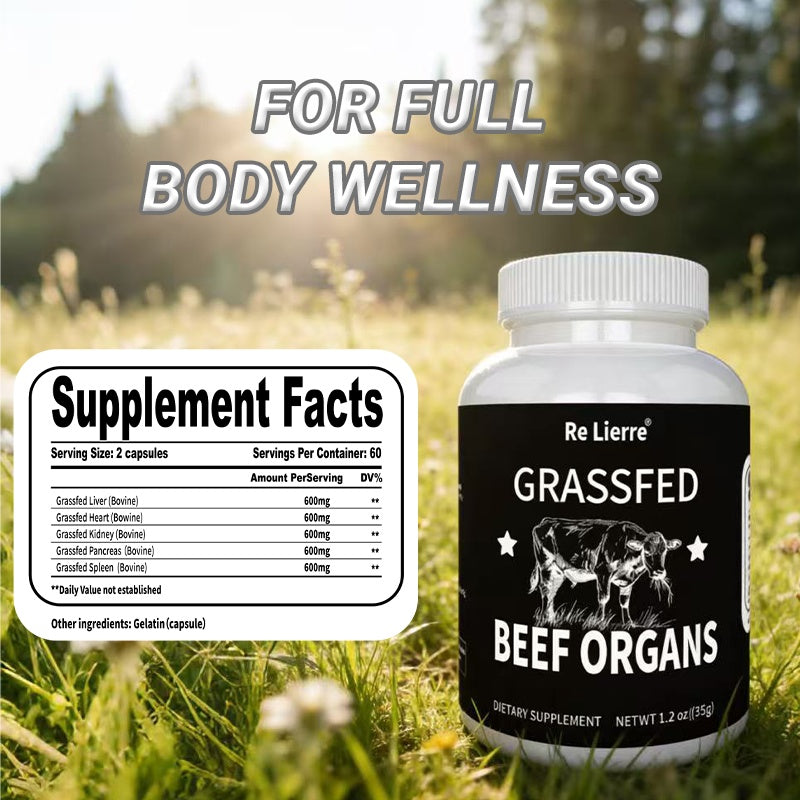
Actual label. Serving size and yield per bottle are printed on the panel.
Begin where they began.
One bottle is thirty days. Most people who stay with this order three at a time, because running out mid-practice is the way practices end.
Day
Word
Take the whole bottle. Every capsule. If you finish it and feel nothing worth the money, send us the empty bottle and we will refund you in full — no forms, no restocking fee, and no one on the phone trying to talk you out of it.